Week 13 – 10th December 2018

Personalised Care Programme Event

On December the 10th we held an event to showcase all of the great work going on across our STP footprint and what a morning it turned out to be! Over 100 people came along to hear about the Personalised Care Programme and what this means in reality. In today’s blog I want to focus on the content of the event, hoping that you may feel inspired to do something similar!


The emphasis of the event was on peoples stories, experience of personalised care and the impact of this, therefore we kicked off the morning hearing about the following four stories:

  • A young boy who attended a ‘magician’ course and through this form of therapy was able to tie his shoe laces and eat with his friends at school lunchtimes after a health condition resulted in significant one sided muscle weakness and lack of movement
  • A mother explained how a Personal Health Budget improved the care and support for her daughter who has very complex health needs and how this is enabling her to be cared for safely and to continue to live at home with her family
  • A lady with a neurological condition who is in receipt of a Personal Budget through social care which is enabling care tailored to her needs whilst allowing her to have a sense of independence, meaning her daughter can to go to work without worry
  • I spoke of my experience as a physiotherapist in delivering personalised care and the barriers that can occur within systems that can limit personalisation of care, questioning where we could and should do more to reduce this.


This was followed by talks from our Voluntary and Community Sector representatives, reflecting on their work but also their lived experience. There was recognition as to the progress services are making in personalisation of care but also the question of how we greater support and promote the voluntary and community sector to be a resource for people in the community, which is likely far more beneficial to people than statutory services. This was demonstrated through the example of an organisation deciding they needed to set up a distraction service for those with drug and alcohol dependency, the question was why? If you find out what is important to the person and what they enjoy then look to the community as to what is already available, which will in effect distract them without creating yet another service.

Our Co-Production group shared their experience with the audience, both members with lived experience and professional colleagues. The piece of work the coproduction group have been working on was shared also, with a big thank you from the STP to all of the group’s efforts. The co-pro group were approached by a lot of people wanting to know more about their work, which is really great to hear and will hopefully sustain this way of working.

I finished the event by quickly (as inevitably we ran over time and lunch was waiting!!) talking about the workforce development that we would like to see happen. We recognise that organisations have undertaken great steps in improving the personalised interaction between people and professionals and that we wish to build upon this. I called for those with lived experience to share their stories in a safe way, for staff to tell us what is happening on the ground and for those in senior leadership positions to commit to allowing staff the time and opportunity to invest in improving the personalisation of services, committing to the sustainability of the programme.

Sandwiched around this, we had a small market place of local services showcasing their work and how this also aligns to the programme; for example community and care navigators.

So all in all it was a really fabulous morning. It was my first experience of putting on an event and on reflection, logistically there were things that we would do differently if we were to run it again. And my main disappointment is the fact we only had a small number of frontline staff in the room – a group I was really trying to ensure were present and had a voice. But on the whole lots of positive feedback was received and people appeared to leave feeling inspired. We put a call out for ‘Frontline friends’ to volunteer themselves to help us continue to the drive and enthusiasm around the implementation of the programme and will be following up with these people in the not so distant future.

I want to say a big thank you to everyone involved, a lot of hard work went on behind the scenes and it was really fantastic to hear how personalisation of care is really impacting people’s lives.
Week 12 (3rd – 6th December 2018)

And I am back! The run up to Christmas is always a busy time, however adding several work events and moving house in to the mix has taken it to a whole other level this year – so I apologise for my absence! Time to catch up on what has been happening…

The 4th of December 2018 was the third NHS England collaborative event for the Personalised Care Programme. I packed a bag and a short drive, 4 trains and a taxi ride later I was in Bristol 🙂 As always the content of the event was really fab with a real focus  on hearing from demonstrator sites as to their successes. Being able to hear how sites across the country are implementing the delivery of personalised care and the journey that they have been on to get to the point they are at, is really reassuring and encouraging. I sometimes feel like there is so much we could do and want to do, but actually turning that into impactful change can be slow and frustrating. I am not necessarily the most patient person, I will admit…  however when aspiring to culture change; I need to remember this cannot happen overnight and will take time! 4 areas of personalised care implementation were discussed; children’s services, frailty, secondary care and primary care and I can honestly say I came away feeling inspired and with fire ignited in my belly again.

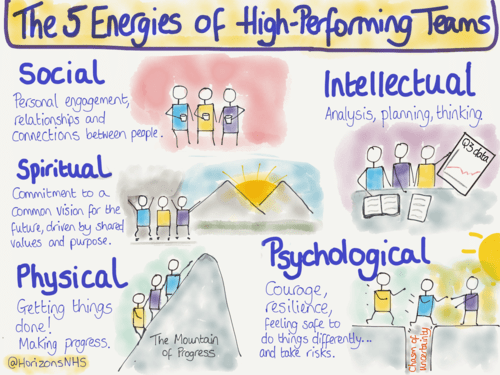
NHS Horizons facilitated the afternoon session with the topic ‘Energy for Change’. Based on my earlier comments about the frustration that can come with change not occurring quick enough (as my impatient self would like) the session really enabled me to consider how my own energy for change may differ from others around me and the areas that we perhaps need to focus on to drive this change forward. In my opinion, I believe that we need to work more on a vision for the future, shared by all across the STP which will then increase spiritual energy – but alongside this we need to improve psychological energy, resulting in the workforce feeling trusted and safe to work in a different way.

energy for change

**Interesting blog from Rosanna Hunt on the model and its role of leadership, which also includes this picture from @HorizonsNHS

https://nhshorizons.passle.net/post/102f6wr/coaching-nhs-leaders-to-build-energy-for-change

Key learning this week:

  • Sometimes you need to reflect back over a longer period of time to really see the value and impact of the work you have been doing

Idea 17: use the Energy for Change model with services to help implement change and analyse where we need to invest time and resource to ensure meaningful effective time – this can be something as simple as a shared lunch or everyone having a one page profile; think outside the box!

Achievements this week:

  • Successfully made it to Bristol and back
  • Managed to keep my head above water in the chaos of this week!
  • Successful prepping for our Personalised Care Programme Event

Plans for next week:

I write this blog for the previous week (or very behind this week!) so we have already held our Personalised Care Event which I CANNOT WAIT to tell you all about next week!

I’m still here…

I just wanted to pop something on my blog to say I am still here! Things have got really busy on a work front – we are in full event planning mode in the run up to our Personalised care event next week. I am also moving house imminently so life is pretty chaotic at the moment but for now, time to pack for the next collaborative event in Bristol tomorrow… I look forward to updating you on everything very soon!


Week 9 (12th – 16th November 2018)

So I am 9 weeks in to this role and what a whirlwind it is has been. Locally, I am learning more and more each day about improvements planned to change the outcome for people living within the STP but this week I got the opportunity to go to NHS England HQ and speak to those working within the Personalised Care Programme to get more of an idea nationally.

I have come to realise that having a vision and trying to get others to believe in that vision around system structures can feel a bit of an uphill struggle. It was really helpful talking to NHS England colleagues who are championing the programme and facilitating sites up and down the country, hearing familiar challenges and also opportunities that sites are working with. It was lovely to hear what further support may be available to help us put our vision in to a reality and there is a real sense of a Personalised Care Network. I have another afternoon planned this week, so look forward to hearing more from other members of staff and my travel is booked for the next collaborative in December 🙂

I accessed my second webinar hosted by NHS Horizons on Thursday and I am pleased to say it was slightly more successful in terms of my technological abilities than last time!! The focus for the webinar was how we scale and make the personalised care movement even bigger. The key learning I took away from this session was the idea of seeking out ‘super-connectors’ within organisations and the theory that if these equate to 3% of the organisation they have the relationships and skills to influence 85% of other people.

Idea 17: We need to find our super-connectors!

Key thoughts this week…

  • A small proportion of people who believe in something strongly can have a huge influence on people around them – most commonly these are people not in a leadership position
  • It is really important to have an understanding of what else is going on nationally with regards to the programme, sharing learning and challenges is paramount to making change happen at a quicker pace

Achievements this week…

  • I have reached out to services to invite them to showcase their work that aligns to the Personalised Care Programme at our event in December
  • Liaising with NHS England colleagues, creating further networks and identifying what other support may be available to facilitate the programme locally

Plans for next week…

  • Spend a second day with NHS England
  • Deliver my first discussion session to a community therapy team to explain about the programme and explore areas whereby people could achieve better outcomes
  • Learn more about services and organisations across the STP that deliver personalised care day in, day out.

Week 8 (5th – 9th December 2018)

My endeavour to capture the level of personalised care staff are giving continues as unfortunately I have not received the number of responses I had anticipated just yet, therefore I have decided to..

Idea 14: change the delivery method of the questionnaire and create an online survey of the same questions to see whether this increases response rate

Idea 15: in order to increase the pace and number of responses – connect with the 3rd CCG in the STP so all community therapists have been sent the survey link to have a holistic picture

I really believe that recognition of frontline staff’s current practice needs to be celebrated and form the foundation of any personalised care training package. The data I have collated to date will form part of the discussion I will have with teams when I head out to meet them over the next few weeks. So far the responses show that within the resources available personalised care is given, but there can be barriers around multi organisational input.

Idea 16: When meeting with therapy teams, explore the options where budgets (whether that be personal health budgets or joint budgets) could provide better outcomes for people

This week I attended my second Strategic Co-Production group whereby we had the ambitious task to complete our input on a piece of work over the last few months, to take back to the STP leads. The respect the members show for each other, their own experiences but also the way they acknowledge and respect the effort that has been put in by organisations on the piece of work they are supporting with, blows me away. The Co-Production group have done a marvellous job and this piece of work has now been handed back to the STP leads; I really look forward to seeing what the Co-Production group will be supporting next and watching this process evolve!

We have decided to have an event in December to showcase all of the great work going on that aligns to the Personalised Care Programme. The focus of the event will be people who are receiving personalised care and the importance of having a ‘different conversation’ with people. When deciding on speakers, I was asked if I would present with regards to my frontline experience and the consideration for workforce development. Now public speaking is not my forte AT ALL and I quickly demonstrated the shade of red I will go on the day!! I have agreed however to talk about a special lady who is very close to my heart and the journey we went on together before, during and now after the 100 day challenge that kicked off my enthusiasm for this programme.

Key thoughts this week…

  • Co-Production is incredibly valuable and although new to this group I am proud of the work they have completed
  • December is fast approaching therefore it’s time to develop event planning skills…
  • Remembering a very special patient to me and sharing her story with people will be really lovely; hopefully practice, practice and more practice will give me confidence in doing so in front of lots of people!

Achievements this week…

  • My Mary Seacole assignments have been submitted so I have finished the course :)Hooray!
  • I facilitated feedback of the Strategic Co-Production groups work back to STP leads
  • All core community therapy teams across the STP have been contacted and now have access to the questionnaire/ survey

Plans for next week…

  • Head to London to meet with NHS England colleagues, round 1 of 2!
  • Continue event planning
  • Collate the further data obtained from questionnaire responses

Blog 7 (29th October – 2nd November 2018)

This week started with our monthly steering group meeting, which seems to have come around extraordinarily quickly since the last one! It was a good opportunity to capture where the programme is currently at and plan for the next steps. I was able to give members an update on the work I had undertaken so far and a quick summary of what I plan to do next. Having this forum is really useful and is something I didn’t know occurred for programmes when working on the frontline. Being part of the steering group and understanding its value has helped consolidate my knowledge of the reasons behind other boards.

I spent some time this week understanding more about our community navigator scheme locally and how this programme is structured. It really struck me that there is an awful lot that clinical staff can learn from how the community navigators communicate with those they work with, which is truly person centred. I was reminded of the difference between social prescribing and signposting. Reflecting on the times that I perceived myself to have delved in to the realms of social prescribing, in reality I realise I was signposting and I think this is something that we need to be cautious of when talking to staff. We are fortunate to have community navigators who build trusting relationships with people, facilitate them in to the community and empower them to then take control of their situation. I hope to go out with the community navigators to see this happen in practice, something I’m really looking forward to.

Key thoughts this week…

  • We need to ensure that people understand the difference between signposting and social prescribing
  • There is essential learning to be shared between all those in different roles who interact with people with regards to having a person centred conversation.

Achievements this week…

  • Improved understanding of roles within STP work streams
  • Better understanding of our social prescribing service

Plan for next week…

  • To have my flu jab – unfortunately I had to postpone it this week due to a horrendous cold.. so another plan is to feel more human!
  • Attend my 2nd co-production group meeting
  • Develop skills in event planning – we want to showcase the programme in December 🙂
  • Submit my Mary Seacole assignments and breathe a sigh of relief!

Week 6 (22nd – 26th October 2018)

So week 6 started with a fantastic meeting with a communications and engagement officer. It was really interesting to understand their role, having not thought much beyond comms as just social media/ newsletters before. We were able to explain about the Personalised Care (PC) Programme and the desire to shout about all the great work going on in the STP that relates to the programme. Because the STP is so vast and as a team of 2, we cannot know about everything, we are therefore considering…

Idea 14: Create a programme email address to be shared across communication streams of all the different organisations in the STP, for people to email us with great practice that aligns with the PC programme that we can then promote/ work alongside.

This blog was discussed also! It may potentially be shared across the STP rather than just through my twitter. I was quick to say if it needs editing then I am happy to do that to make it better before its shared further- but it was made clear that the purpose of a blog is to be a space to be yourself and document your thoughts, not to be a polished article. I reminded myself why I started the blog – to share my transition from a clinical role in to a programme role. I am no expert in this and it will not always be pretty but if it helps one other person, or someone is able to share their own experiences; it has served its purpose 🙂

On Tuesday, I took part in my first webinar. Whilst to my parents I am a technology whizz, I ended up dialling in as my laptop was misbehaving, my laptop then decided to work and opened up two pages so I was in the webinar 3 times! But better than none at all I guess!! The Webinar was run by NHS Horizons and was to consider the Vision and Shared Purpose for the Personalised Care Programme. The NHS Horizons team started by breaking down the term ‘Our Shared Purpose’. Who are the our? What are we sharing? And what is the purpose? I realised this was so simple, but how many times are phrases used without the consideration for what it actually means or that we’re trying to convey? I’m looking forward to working on this further.

Key thoughts this week…

  • Communications teams play a huge role in the delivery of a service which I had not appreciated before. I look forward to working alongside the STP communications team from here on in
  • Simple phrases can have a far greater meaning which should really be considered before using as common terminology

Achievements this week…

  • Being part of my first webinar! (Minus a few technical glitches…)
  • Identifying a range of other services that would be interesting to work with, that align to the programme

Plans for next week…

  • Attend the Steering group for the Personalised Care Programme
  • Learn more about social prescribing in the STP
  • Refine my personal development needs within this role through supervision
  • Have my flu jab! #flufighter


Week 5 (15th – 19th October 2018)

I kicked off this week with celebrations for National #AHPsDay by attending an event which was run across our STP organisations. The 14 professional groups that make up Allied Health Professionals (AHP) are the third largest workforce in the NHS. It was really lovely to meet AHP’s from different services and organisations, celebrating work that we do and to start planning our impact for the future. It was inspiring to hear from the STP leads that there is the belief AHP’s hold the key to making NHS services sustainable for the future.

Discussion was had around progression opportunities for AHPs; in my own experience, senior lead posts are often filled by nurses or medics. There was a real emphasis on the fact AHPs have a responsibility to promote our skills and should push to have greater representation in senior lead positions. I feel proud that I have been able to take a step in to a non-clinical role, promoting the use of my skills in another way. Although I am very happy in my current role (especially if my Programme Lead reads this!), for AHPs to have a real voice I will continue to think… what next for me?

Questionnaire responses

I have collated the initial responses I have had to the questionnaire I sent to community therapists – as I expected 100% feel they deliver personalised care, fantastic! I also asked the following questions…

  • Please rate your confidence of delivering personalised care (0 being not confident to 10 being extremely confident)
  • Would you consider yourself to have gone above and beyond what is expected of your role that may demonstrate personalised care? (please give examples)
  • What impact does this have on your patients?
  • How does this make you feel?
  • Are there any barriers to delivering personalised care in your working role?
  • Do you see any opportunity to improve the personalisation of care in your role, if so how?
  • Are there any training needs/ resources you need to deliver improved personalised care?

I asked about current knowledge of NHS England’s personalised care programme and whether there is interest to know more about the programme locally. Communications is something I have become really passionate about and the results so far suggest there is work to do around raising the profile of the national programme and  also interest in local programme activity.

In order to have greater understanding of how professional groups are working as a foundation for facilitation of training I need to gather more data, therefore…

Idea 14: Send the questionnaire out to further community therapy teams across the county

Idea 15: Consider sending the questionnaire to other professional groups such as community matrons/ specialist services

Key thoughts this week…

  • The importance of pushing professional boundaries and promoting the skills you have in order to move in to non-clinical leadership roles. AHPs do have a voice – we just need to shout louder!
  • The importance of collecting data to inform change and also the challenges that can come with collecting data from people. Personally I have been known to be a bit rubbish in filling out questionnaires, so here is my pledge that from now on I will make a conservative effort to give feedback and respond to questionnaires!


Achievements this week:

  • Naming the 14 professions that make up AHPs – surprisingly harder than you may first think!
  • Networking, Networking, Networking
  • Reaching out to other professional groups to send my questionnaire to, in order to gather further information on staff’s current perceptions of the personalised care they give

Plans for next week:

  • Meet with the communications team to discuss promotion of the programme locally
  • Attend a frailty event to better understand the STP plans with regards to this work stream
  • Continue planning and thinking about workforce development


Week 4 (8th – 12th October 2018)

This week marked the year anniversary of the start of the 100 day challenge which introduced me to the Personalised Care programme, how different my life is now to that first day when I turned up not really having a clue what I was about to become a part of!

On the year anniversary, fittingly I attended an event run by Nesta’s People Powered Results team along with other people who have taken part in a 100 day challenge across the country. Whilst people’s efforts were focused on different outcomes within their own challenges, it was really helpful to hear the successes but also challenges of other teams. It appeared to me that teams that had been focused on a particular department made far greater sustainable change than those teams that were across organisations (like mine). On the whole though the feel was small scale rapid testing was a really great way to give frontline staff a voice and put ideas in to action quickly, that may not otherwise be given the chance. I found myself thinking that ideally the workforce development training I plan to do will go across organisations and skill mixes; based on my above observations how do we ensure change is sustainable?

Idea 11: Identify champions within teams to continue shouting about the importance of personalised care and keep the energy within the teams

Locally, we have begun discussions about how workforce development may look; considering we have a STP to work with, do we start small around localities or go big?! We know that staff from different organisations have already received a degree of training on self-management/ health coaching/ how to have a different conversation. I’m wondering if there are elements of all that would be great to pull together to create a programme that will be applicable to all staff interacting with people in line with the Personalised Care programme? This discussion was just the teeniest tip of the iceberg and the beginning of many more discussions to come, but it was great to get started!

Idea 12: Reach out to learning and development departments to understand what level of training staff already have access to with regards to health coaching (or similar) across all the organisations in the STP.

Key thoughts this week…

  • It was really lovely reading the first responses to the questionnaire I distributed to community therapists – there are some really inspiring stories which need to be championed and shared, which most certainly demonstrated personalised care
  • Small scale rapid testing is great but how do we upscale it AND make it sustainable.
  • This job role has the potentially to grow and grow and grow!


Achievements this week…

  • Successfully dredged back through my mind to secondary school IT classes to create an excel spread sheet for the questionnaire responses – it looks pretty good if I do say so myself, although it may not make sense to anyone else!!
  • Improved my understanding of how my STP is currently doing in line with NHSE’s Personalised Care programme targets
  • Sharing my experience of self-management/ health coaching training from a clinical perspective and the influence of this on my practice to help shape the work we plan to do
  • ✓ Idea 4: Start a map of how systems interact and link locally which could be shared with clinical staff to improve knowledge and understanding


Next week I plan to…

  • Attend a STP event to celebrate National AHP day on Monday 15th October
  • Hear more about exciting projects going on already within the STP that may align with the programme
  • Reach out to further teams to get more responses to the questionnaire on staff’s current perceptions of personalisation of care within their current practice.

Week 3 (1st – 5th of October 2018)

And just like that, it is October! This year seems to be flying by and in particular this week seems to have gone by in a flash. My diary is getting fuller and I have been going from meeting to meeting, so perhaps this is why! I have continued my fact finding mission in said meetings, hearing more about what is happening across the STP footprint. There really is a lot of good work already going on and great ideas being generated – but it strikes me that communication with staff is always the bit that lags behind. Perhaps I am one step ahead as finished products do get communicated to a degree; but it makes me proud being a health professional and also a resident of this county, knowing that people are endeavouring to change the ways in which we work and enable our population. If projects were promoted during the design/ planning phase, who knows what extra value people may bring to support the idea?!

Idea 7: Arrange a meeting with the communications team to help me plan how to proceed forwards in promoting the programme.

I got the opportunity to meet our strategic co-production group this week – what an excellent group of people. The workshop had a mixture of people with lived experience and professionals from a variety of areas; we were put to work on a task to help shape a piece of work going through the STP at present. Having been through the 100 day challenge, I have had a glimpse of working alongside those with lived experience but I really valued the experience to work with a greater number of people. Everyone was given the opportunity to express their views on an even platform and it really felt as though progress was being made with this particular piece of work. I really hope the co-production group is embedded in the future to help shape a range of decisions in health and social care, as a frontline professional decisions can often feel hurried and impersonal and the co-production group would help to reduce this.

Idea 8: Is there an opportunity for the co-production group to support my role in workforce development? Whether this is in the content or facilitation of delivery of training.

On Wednesday I attended a regional social prescribing event. I really wanted to attend this event to understand more about the movement that is social prescribing and how the community sector is evolving to meet the shift from ‘medical prescriptions’ to social prescribing. This is something I‘ll admit I am cautious of  in terms of work force development– are the resources and diversity of said resources out there as either a continuum of or potential alternative to statutory services?

At the event, I realised I have been really fortunate in my physiotherapy practice to be able to send referrals to our community navigator service when I have jointly identified a need with my patients that goes beyond my intervention/ skills. Discussion and debate took place as to the role of ‘link workers’ and governance around those who will be providing community based services on the ground. There was talk of social prescribing being everyone’s responsibility and not just link workers – whilst I agree it most definitely is, I know that I could have given a disservice to my patients by only informing them of services I am aware of in the community, as opposed to referring them to one of the community navigators who I am sure, would have given them enriched information and numerous options and opportunities. I am thankful that this is an established service within the area I have been working, but realised beyond the referral process I know little about how the service is delivered.

Idea 9: Spend time understanding the community navigator role from a service provision point of view but also request to shadow workers.

Key thoughts this week…

  • Strategic co-production is incredibly powerful
  • Before I go and talk to the workforce I need to understand in my mind exactly how the process of delivering personalised care may look from start to finish around professional roles. Although in reality this will be and should be different for each individual receiving the care, I find practical examples can really help to bring to life the idea.

Idea 10: Start collating snippets from my physiotherapy experience where personalised care has made a real impact to patients, ready to share as part of the workforce development training.

Achievements this week…

  • Meeting our local strategic co-production group and seeing the impact of this group in action!
  • Making further contacts and arranging meetings to help me understand social prescribing in greater detail
  • Championing work that is already taking place in my STP in line with the personalised care programme at regional events
  • I have completed my last Mary Seacole workshop day… only 2x assignments left to complete now.

Next week I plan to…

  • Consider how training for the workforce may look – what elements need to be included? Who can help with the delivery of training? What foundations can we already build upon?
  • Head in to London for a workshop with Nesta to evaluate the experience of a 100 day challenge with regards to implementation of change – I’m really looking forward to this!
  • Collate data from questionnaire responses sent to community therapists
  • Plan one of my Mary Seacole assignments – the purpose of the assignment is to discuss a change you have implemented in the workplace.. my new job role now fits perfectly!